A decade ago, Prescient Investment Management identified a structural gap at the heart of South Africa’s infrastructure financing market and moved to fill it. Since launching its Clean Energy Fund in 2015, the firm has deployed more than R10 billion across 60 projects, generating 2.9 gigawatts of clean power and supporting nearly 3 700 jobs, the majority in some of the country’s most under-resourced provinces. As South Africa continues to grapple with an energy crisis and widening infrastructure deficit, our experience offers a template for how institutional capital, structured correctly, can simultaneously deliver competitive returns and measurable development impact.
By: Conway Williams, Head of Credit at Prescient Investment Management.



The Problem that Needed Solving
When we entered the infrastructure investing space a decade ago, it was in response to what we believed was a confluence of national imperatives and market inefficiencies in South Africa. The primary problem was a significant funding gap for critical infrastructure projects, which are essential for the nation's development and for narrowing the persistent inequality gap. The South African government's National Development Plan highlighted the need for extensive development in areas such as power, water, sanitation, and housing, and actively sought the participation of institutional investors to achieve these goals.
At the time, the infrastructure funding market was dominated by the top five South African banks, leading to a lack of competition, inefficient pricing, and constrained liquidity. We also recognised that commercial banks were reaching their limits in holding long-term debt for projects such as renewable energy, partly due to the capital requirements under Basel III. Furthermore, asset managers were well-suited to provide the inflation-linked debt that project companies needed to match their inflation-linked revenues.
Our strategy was designed to address these issues directly by providing complementary funding sources. The aim was to increase liquidity, improve pricing through competition, and offer the market the inflation-linked debt products it needed, thereby catalysing further growth in the clean energy and infrastructure sectors.
The Impact of the Infrastructure Strategy Over the Past Decade
The impact of Prescient's clean energy and infrastructure strategy over the past decade is best reflected in the tangible outcomes of our Clean Energy and Infrastructure Debt Funds. The launch of the Clean Energy Fund in 2015 and the Infrastructure Debt Fund in 2021 were pivotal moments, and the combined impact, as at December 2025, is summarised below:
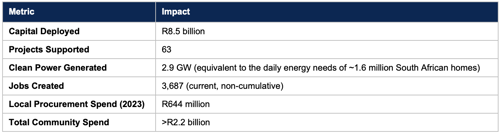
These figures demonstrate a significant contribution to South Africa's infrastructure development, energy security, and economic growth. The creation of jobs, particularly in impoverished provinces like the Northern Cape (where 54% of the jobs are located), and the substantial community spend highlight the strategy's positive social impact.
Balancing Risk, Returns, and Long-Term Impact: A Recent Project Example
A recent example that illustrates how Prescient Investment Management balances risk, returns, and long-term impact is our partnership with GIBB-CREDE, a specialist infrastructure investment and development platform. This partnership combines the technical engineering expertise of the GIBB Group with the financial structuring skills of CREDE Capital Partners, creating a powerful combination to de-risk complex projects.
Through this partnership, we are involved in developing of 420 MW of renewable wind projects under Bid Window 5. These projects are in their final stages and are expected to become fully operational in early 2026.
This project demonstrates a balanced approach:
- Risk mitigation: By partnering with GIBB-CREDE, we leverage deep technical and engineering expertise to conduct thorough due diligence and ensure projects are well-structured and managed throughout their lifecycle. This mitigates construction and operational risks.
- Financial returns: The projects are structured to attract institutional investment, providing reliable, long-term, inflation-linked returns, which are attractive to Prescient's clients.
- Long-term impact: The 420 MW of clean energy will make a significant contribution to South Africa's energy security and transition to a low-carbon economy. The projects also drive local job creation, skills development, and economic growth in the surrounding communities.
This example illustrates how our strategy goes beyond simply providing capital and involves deep partnerships and a hands-on approach to ensure projects are not only financially viable but also deliver lasting positive social and environmental outcomes.
Lessons in Building a Resilient Infrastructure Platform
The past decade has yielded several important lessons in building a resilient infrastructure platform:
- The importance of a differentiated offering: From the outset, we recognised the need to offer products that the market was not providing, such as inflation-linked debt, which were ideally suited to both the underlying projects and our clients.
- A holistic and integrated ESG approach: Our 2025 Responsible Investing Report emphasises that ESG is not an add-on but a core part of our investment process. This integrated approach, which considers a wide range of environmental, social, and governance factors, is crucial for managing risk, identifying opportunities, and ensuring the long-term sustainability of investments.
- The power of strategic partnerships: Our experience demonstrates the importance of partnering with specialists who bring deep expertise in their respective fields. These partnerships are critical for de-risking projects, ensuring their successful execution, and maximising their impact.
- Full-lifecycle involvement: A resilient platform requires more than just capital allocation. Our approach involves active participation throughout the project lifecycle, from origination and construction to operation. This active involvement enables better risk management and ensures projects remain on track to deliver their intended outcomes.
- A long-term value-creation mindset: Our CEO's message in the 2025 Responsible Investing Report highlights the importance of navigating short-term market fluctuations while focusing on long-term value creation. This requires a disciplined, data-driven approach and a commitment to core principles, such as capital preservation.
By embracing these lessons, we believe we are building a resilient infrastructure platform well-positioned to continue delivering attractive financial returns and positive, sustainable development outcomes for our clients and South Africa.
Disclaimer
Prescient Investment Management (Pty) Ltd is an authorised Financial Services Provider (FSP 612). No action should be taken on the basis of this information without first seeking independent professional advice.
Please note that there are risks involved in buying or selling a financial product, and past performance of a financial product is not necessarily a guide to future performance. The value of financial products can increase as well as decrease over time, depending on the value of the underlying securities and market conditions. There is no guarantee in respect of capital or returns in a portfolio.
The information contained herein is provided for general information purposes only. The information and does not constitute or form part of any offer to issue or sell or any solicitation of any offer to subscribe for or purchase any particular investments. Opinions and views expressed in this document may be changed without notice at any time after publication and are, unless otherwise stated, those of the author and all rights are reserved. The information contained herein may contain proprietary information. The content of any document released or posted by Prescient is for information purposes only and is protected by copy right laws. We therefore disclaim any liability for any loss, liability, damage (whether direct or consequential) or expense of any nature whatsoever which may be suffered as a result of or which may be attributable directly or indirectly to the use of or reliance upon the information. For more information, visit www.prescient.co.za